
An afternoon with AI turned into a bigger question about the economics of creative work.
It started as an experiment.
No business plan. No pitch deck. No big declaration that I was starting an agency. Just an afternoon pushing a few AI tools and seeing how far I could take them.
I've spent much of my career in design, UX, branding, and creative direction. I've also seen enough technology cycles to be skeptical of anything introduced as the future of everything.
But this one had me thinking.
Not because AI consistently makes better creative. It doesn't. Because it changes how much an experienced creative person can produce, test, and refine without assembling a traditional production team.
That led me to a question I hadn't intended to spend the afternoon investigating: Who still pays for creative—and could there be a real business in delivering it differently?
The creative budget hasn't disappeared. It's being reallocated.
The idea that companies have stopped spending on creative doesn't hold up. In September, the Interactive Advertising Bureau raised its forecast for US advertising spending growth in 2026 to 12.3%. That's advertising spend, not a forecast for design fees, but it's evidence that brands still need to compete for attention.
At the same time, Gartner's 2026 CMO Spend Survey found marketing budgets averaging 7.8% of company revenue among surveyed marketing leaders—barely up from the year before. Gartner's sample was primarily large companies, so I wouldn't apply that percentage directly to a local business or a boutique agency.
The tension is more useful than either number alone: companies need a steady stream of creative, but budgets aren't growing much, and the cost and structure of traditional agency production are under pressure.
That's the opening I'm curious about. Not selling people more AI. Selling them a better way to get real creative work done.
The tools are common. The judgment isn't.
Here's the inconvenient truth for anyone thinking about an AI agency: knowing how to prompt isn't much of a competitive advantage anymore.
Forrester reported in June 2026 that nine in ten US marketing agencies in its research were already using generative AI. It's not a novelty hiding in a corner of the industry. It's becoming part of the basic toolkit.
But adoption isn't the same as excellent output.
The Content Marketing Institute's November 2026 research found 78% of surveyed B2B marketers identified speed as AI's most significant contribution, while only 17% said it had contributed to quality. They also described struggles with accuracy, quality, and brand authenticity.
That gap matters.
A tool can generate a hundred directions before lunch. Someone still has to recognize which one is worth pursuing, which one is off-brand, and which one looks impressive until you ask whether it actually communicates anything.
Production is becoming easier to access. Taste, context, and accountability are not.
That's where I think a senior creative-led AI studio could create value.
Who I'd actually sell to
My first instinct was to look for any company that needed design. That's too broad—and probably the wrong way to start.
The stronger prospect is a company that already buys creative, already understands its value, and needs more capacity.
E-commerce brands come to mind because they're continually testing product imagery, campaign concepts, and paid-social variations. Multi-location businesses need a consistent brand translated into many local executions. B2B technology, coaching, and education companies need landing pages, events, campaigns, and content. Larger real estate brokerages and development firms need cohesive launches, not just one-off graphics.
But the audience that caught my attention most was small marketing and creative agencies.
They've already done the hard part: they have clients, trust, strategy, and relationships. What they don't always have is unlimited production capacity. That makes a specialized, white-label creative partner worth exploring.
My provisional ideal customer is a marketing director or agency founder managing recurring campaigns with a lean team—not a solo business owner who has to be convinced to spend money on design.
The agency models I've been studying
I spent time looking at boutique agencies around Boise and the broader Northwest, not to rank them or to find anyone who "needs AI," but to understand the different ways good studios are built. A few patterns stood out:
Content collectives. Small teams covering strategy, social, design, photography, and short-form video, often working alongside outside creatives. Flexible partnerships are already part of how they deliver.
Performance and paid-media shops. For them, the need for fresh creative doesn't end at launch. The work is iterative: test, learn, change, repeat.
Integrated brand, digital, social, and PR agencies. They show how much execution sits behind one campaign—and why coordination and consistency matter as much as generating assets.
Lifestyle and luxury-focused agencies. A reminder that speed alone won't sell premium work. The output has to feel considered.
Strategy-led brand studios. The kind of thinking I'd never want AI to flatten into interchangeable templates.
Intentionally small specialist studios. Some firms sell focus and a distinct point of view, not volume—an important counterexample to the idea that every studio wants to scale endlessly.
Brand-system and packaging studios. Their quality comes from a coherent system. Once that system exists, additional production becomes an interesting place for AI assistance.
Multidisciplinary studios that welcome project collaborators. Proof that the agency world already runs on trusted specialists.
Fractional creative leadership. Experienced creative talent delivered flexibly, instead of through traditional staffing.
Long-term marketing partners. The longer a partner understands a client's business, the more useful that creative relationship becomes.
Looking at these models, I don't see an industry waiting to be disrupted. I see reminders that the actual product of a good agency isn't a pile of deliverables. It's judgment, consistency, relationships, and outcomes.
A credible AI production partner would need to protect those things, not undermine them.
The business model worth testing
The model I'm testing is a white-label creative partnership: an agency brings a brief and brand system; a senior-led production studio develops campaign directions and turns an approved direction into ready-to-use assets. The agency keeps its client relationship. The production partner provides focused capacity.
No vague promise of unlimited design. No claim that everything will take five minutes. Just clearly scoped work with deadlines, revision limits, and quality standards.
There is precedent for subscription-based creative production at a much larger scale. Superside advertises subscriptions starting at $15,000 per month on an annual commitment. I'm not trying to recreate that company. I'm interested in whether smaller teams need a similarly dependable production relationship at a more accessible scope and price.
The monthly plans on this site are my first version of that test. I want to know how long the work actually takes, what review cycles look like, whether clients can use the assets immediately, and whether they come back.
The first experiment doesn't need fifty clients. It needs a handful of conversations, one paid project, and a clear understanding of the margins.
Why I didn't start with the website
Here's the funny part: as a designer, I could have spent a month crafting the identity, choosing typography, building the website, and convincing myself I'd made significant progress.
That would have been very comfortable. It would also have let me avoid the most important question: Will someone pay for this?
So I resisted the urge to start with the branding. Mostly. (You're looking at the "mostly.")
The plan is simpler: make excellent work, show it to people who already purchase creative services, understand where their process breaks down, and see if a real project follows.
Maybe it grows into a boutique AI-native studio. Maybe it stays a lean white-label production partner. Maybe it remains an experiment that sharpens how I lead creative work.
All useful outcomes.
What's left when everyone can make things?
The part I keep coming back to is the distinction between making and deciding.
AI is becoming surprisingly good at making. Creative direction is the discipline of deciding what deserves to be made, why it matters, and whether it worked.
When production gets cheaper, those decisions don't become less important. They become more visible.
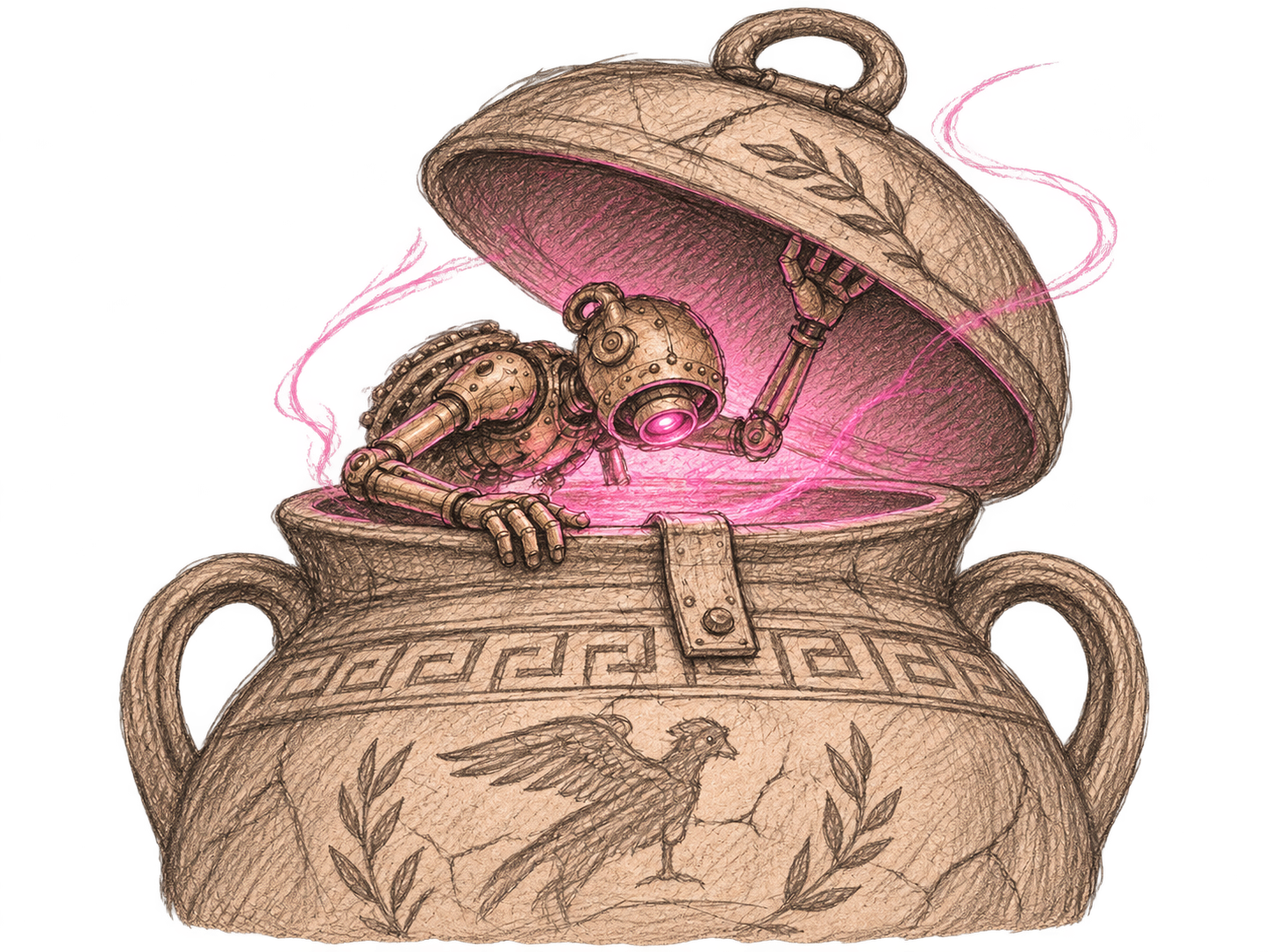
So this isn't really a story about replacing designers with robots. Even if I've been having a good time inventing little ones.
It's a question about building a different kind of studio: one that uses the machines for speed and leaves the important judgment to people.
Less production friction. More creative thinking. Better work.
That's the hypothesis. Now I'm testing it.
An independent creative-business experiment. The agency models described are based on public research of Northwest studios; none are clients or partners. Market figures are cited from their original sources; services and pricing are still being tested.
Run an agency that needs more creative capacity? Let's talk.